A gold rush is happening in commercial real estate right now. Smart investors do not want to miss it.
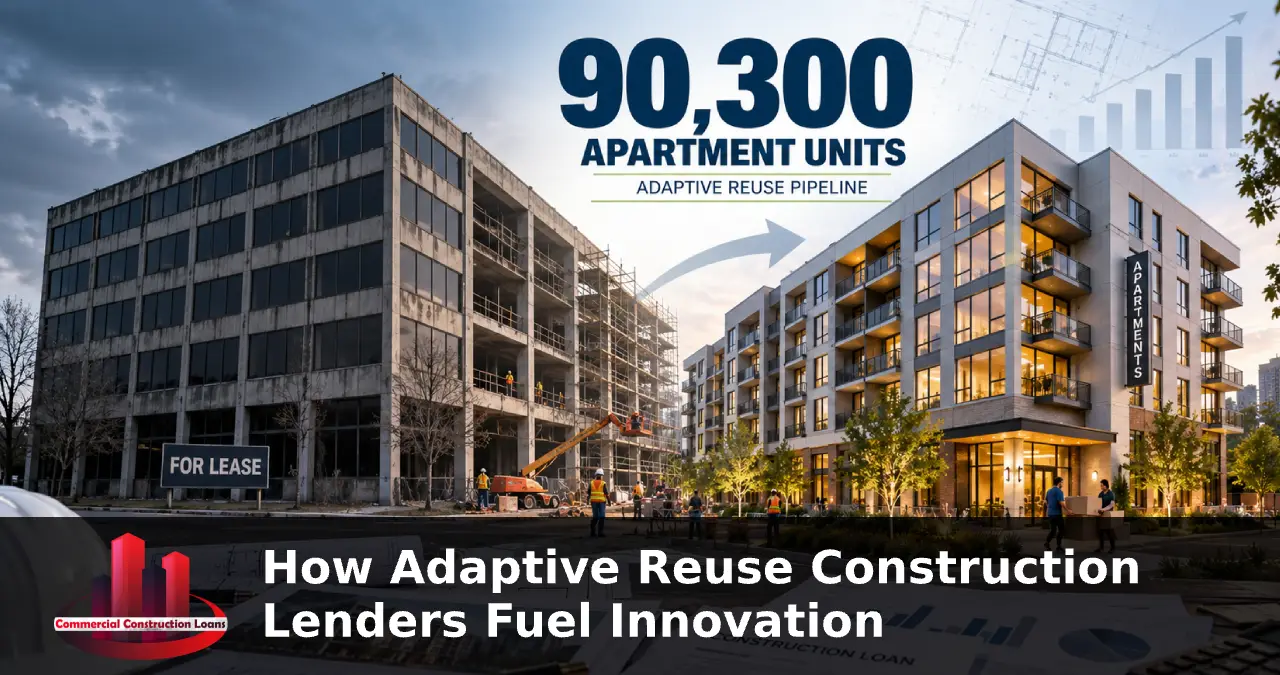
Office conversions hit a record 90,300 apartment units in the national pipeline this year. That is a 28% jump from last year. New York, Washington, D.C., and Chicago lead the way. Office space now makes up 47% of all adaptive reuse projects nationwide.
At the same time, national office vacancy sits near 17.7% to 20%. Some cities are far worse. San Francisco has hovered in the high 20s to low 30s for years, though a wave of AI-sector leasing is finally pulling that number down.
Housing tells the other half of the story. A record 22.7 million renter households now spend more than 30% of their income on rent. That number comes straight from Harvard’s Joint Center for Housing Studies, and it is the highest ever recorded.
Put these two facts together, and the opportunity becomes clear. Empty offices sit on one side. A housing crunch sits on the other. Smart developers are not waiting for new land or new steel. They are buying old buildings and turning them into homes, hotels, and shops.
To do this well, you need the right partner. You need adaptive reuse construction lenders who understand how these deals work. CommercialConstructionLoans.Net has spent 30 years underwriting complex builds as a direct wholesale lender, table funder, and correspondent lender, closing deals across 75 distinct loan programs.
Why Adaptive Reuse Is Winning Right Now
Ground-up construction is slow and expensive. Materials cost more each year. City permits can take years to clear.
Reusing an old building skips most of that pain. The foundation is already poured. The steel is already standing. You do not start from zero.
Here is what the data shows:
Lower cost. Some conversions cut hard construction costs by more than half compared to a full teardown and rebuild. The Radex Park industrial conversion in Poland hit 56.95% in direct savings versus demolition, though savings vary widely by project and building type.
Faster timelines. Most conversions finish 25% to 40% faster than new builds, since crews skip excavation and structural framing.
Lower carbon footprint. Studies from the American Society of Civil Engineers point to major carbon savings from reuse versus new construction, since the embodied carbon in existing concrete and steel never has to be replaced.
Strong returns. The Radex Park case study alone delivered close to $1.93 in combined economic and environmental value for every $1.00 spent, though this figure reflects one project rather than an industry-wide average.
| Metric | Adaptive Reuse | New Construction |
| Hard cost savings | Up to 56.95% (project-specific) | Baseline |
| Delivery speed | 25% to 40% faster | Standard timeline |
| Carbon footprint | Meaningfully lower | Higher |
| National conversion pipeline (2026) | 90,300 apartment units, up 28% YoY | N/A |
Value-Add Financing Strategies That Actually Work
You cannot fund a big conversion with one simple loan. Smart developers stack several sources of money together. This keeps your own cash low and your returns high.
Federal Historic Preservation Tax Credits
This is the biggest prize for historic buildings. The Federal Historic Preservation Tax Incentives program gives you a 20% tax credit on qualified rehab costs.
The numbers speak for themselves. In fiscal year 2024, the program generated $12.8 billion in economic output and supported roughly 116,000 jobs. In 2025 alone, it helped create or restore 21,934 homes nationwide.
You can sell these credits to outside investors for cash. That cash becomes equity in your deal. You borrow less, and your lender takes on less risk.
Low-Down-Payment SBA Loans
If you plan to run a business inside your converted building, SBA financing is hard to beat.
SBA 504: A bank funds 50% of the project. A Certified Development Company funds 40% through a government-backed debenture. You put down just 10% in cash, and the rate locks in for up to 25 years. Full program details live on the SBA’s own 504 loan page.
SBA 7(a): This program offers up to $5 million for purchase, buildout, and working capital, with terms stretching to 25 years.
Grants, Opportunity Zones, and Clean Energy Funding
Cities want their empty buildings fixed. Many offer grants for planning, environmental cleanup, and architectural work.
If your property sits in a designated Qualified Opportunity Zone, you may also be able to defer or reduce capital gains taxes on the equity you reinvest into the project. This is a tool many developers overlook when they only focus on historic credits.
C-PACE financing is another option. It funds HVAC, windows, solar, and roofing with a fixed-rate loan repaid through your property tax bill over 20 to 30 years.
Private Equity and Mezzanine Debt
Large conversions often need one more layer of capital. Private equity or mezzanine debt fills the gap between your senior loan and your own cash. It costs more than bank debt, but it lets you close deals that would otherwise stall.
| Capital Layer | Position | Typical Share | Cost or Return |
| Senior Construction Loan | First Lien | 50% to 65% LTC | SOFR + 300 to 550 bps |
| SBA 504 Debenture | Second Lien | Up to 40% LTC | Below-market fixed rate |
| C-PACE | Tax Assessment | 10% to 20% LTC | 6.50% to 8.75% fixed |
| Historic Tax Credits | Non-Debt Equity | 10% to 20% of cost | Sold at $0.80 to $0.92 per credit |
| Mezzanine or Preferred Equity | Subordinate Lien | 10% to 15% LTC | 11% to 15% return |
| Developer Cash | Common Equity | 10% to 15% minimum | Project upside |
What Lenders Actually Check Before They Fund You
Getting approved comes down to hard numbers and hard engineering. Here is what underwriters look at first.
Loan-to-Cost (LTC)
LTC = Total Loan Amount divided by Total Construction Cost, times 100.
Most lenders cap this between 65% and 85%. You fund your equity first. The lender releases draws after that.
Debt Service Coverage Ratio (DSCR)
DSCR = Net Operating Income divided by Annual Debt Service.
Lenders want to see 1.20x to 1.35x once your building is leased up. This is one of the most important ratios in all of commercial lending, so it pays to understand it before you apply.
Debt Yield
Debt Yield = Stabilized NOI divided by Total Loan Amount, times 100.
Most top lenders want to see 8.50% to 11.00% here. It tells them what they would earn if they had to take the property back.
The Physical Checks
Old buildings hide surprises. Expect your lender to require:
- Floor plate review. Pre-1945 buildings tend to be narrow and bright. Glass towers built after 1960 often have deep, dark centers that need creative light solutions.
- Plumbing and power upgrades. Turning one office bathroom into dozens of apartment kitchens and baths can eat up 30% to 45% of your hard cost budget.
- Slab testing. Engineers must confirm the concrete can handle new pipe runs before anyone starts drilling.
- Environmental review. Older buildings often hide asbestos or lead paint. Expect Phase I and Phase II assessments, plus a 10% to 20% contingency reserve.
Many developers now use 3D laser scanning and building information modeling before construction starts. This maps every hidden pipe and beam in advance, so crews are not surprised mid-project and draws stay on schedule.
Comparing Your Loan Options
Every lender handles conversion risk differently. Here is how the main options stack up.
Short-term bridge loans run 12 to 36 months at 7.00% to 12.00% interest. They fund the purchase and pay draws as work gets done. Speed is the main advantage.
Wholesale and table funding gives brokers and borrowers access to lite-doc, no-doc, DSCR, and stated-income programs that most retail banks will never offer. If your local bank already turned you down, this route deserves a look. Our own team recently walked through why banks are rejecting more construction requests than they used to, and what that means for your options.
Long-term takeout loans pay off your construction debt once the building is fully leased. HUD’s Section 221(d)(4) program offers up to 85% to 90% loan-to-cost with a 40-year fixed rate for multifamily conversions. Fannie Mae, Freddie Mac, and life insurance companies offer similar permanent options for stabilized properties.
If you are converting an office building specifically, we also break down financing paths in more depth in our guide to office-to-residential conversion loans.
Real Projects, Real Numbers
160 Water Street, New York City. A 24-story, 1970s office tower sat nearly empty. Developers cut vertical light shafts through the core, added three new floors, and delivered 588 apartments for over 1,000 residents. Total financing exceeded $250 million, blending senior debt, preferred equity, and clean energy funding. This project is part of a wider wave that Forbes recently profiled across major U.S. cities.
The Newark Arcade, Ohio. A $21 million stack combined a $9.45 million bank loan, $6.30 million in historic tax credit equity, a $2.10 million city grant, and $3.15 million in developer cash. The result: 24 shops and 19 apartments inside a restored, glass-roofed arcade.
Motto by Hilton conversion. A vacant brick warehouse became a boutique hotel through a $28 million stack: a $13.20 million first-lien mortgage, $5.60 million in historic tax credit equity, a $5.00 million SBA 504 debenture, and $4.20 million in developer cash.
Radex Park, Poland. Four outdated industrial buildings became modern manufacturing space. The project achieved 56.95% direct cost savings versus demolition and prevented over 48,000 metric tons of carbon emissions.
The Real Challenges You Will Face
Zoning still gets in the way.
Most cities separate commercial, industrial, and residential zoning. Converting an office to apartments often means securing a variance or qualifying for a city overlay program. Cambridge’s Affordable Housing Overlay, for example, now allows buildings up to 15 stories with no parking minimum, which has dramatically cut annual carrying costs for some projects. Confirm your target property allows residential or mixed use by right before you lock in financing.
Historic rules can clash with modern codes.
Historic tax credits require you to follow the Secretary of the Interior’s preservation standards. At the same time, you must meet modern fire, safety, and accessibility codes. If a new exit stair damages a historic facade, the National Park Service can pull your credits. Get your lender and architect to review plans together early.
Hidden costs still happen
Old blueprints go missing. Crews find beams and pipes nobody mapped. That’s why 3D scanning and digital modeling have become standard practice on serious conversion projects. It costs money upfront and saves far more later.
| Risk | Cause | Fix |
| Zoning mismatch | Commercial zoning blocks housing | Use adaptive reuse overlays |
| Tax credit loss | Work breaks preservation rules | Get NPS approval before closing |
| Hidden contaminants | Undocumented asbestos or lead | Require Phase II assessment |
| Slab failure | Weak concrete during drilling | Run 3D scans and load tests |
| Rate spikes | Long build timelines | Use interest rate caps |
Why Work With CommercialConstructionLoans.Net
Rigid local banks often reject adaptive reuse deals because they do not fit a standard checkbox. That is where a flexible lending partner matters.
As a direct correspondent lender, wholesale lender, and table funder with 30 years of underwriting experience, we structure deals across construction and renovation, government-backed programs like SBA and HUD, bridge and private debt, permanent agency loans, and flexible lite-doc programs. If cash flow is tight mid-build, we also offer options built specifically for stalled or distressed construction projects. We also run exclusive and non-exclusive broker referral programs for real estate professionals who want dedicated deal support.
Learn more about our full range of loan products, or read more on our blog for deeper dives on private debt, bridge financing, and construction lending trends. Ready to move forward? Contact us today for a term sheet.
FAQs
Can I use historic tax credits on my personal home?
No. The federal credit only applies to income-producing commercial or rental buildings, not private residences.
Do lenders always require slab testing?
Yes. Nearly every lender requires structural review and non-destructive testing before contractors drill through existing concrete for new plumbing or wiring.
Can I get financing with no prior conversion experience?
Often, yes. Wholesale and table funding lenders will pair inexperienced borrowers with a proven general contractor, focusing more on property equity and budget quality than your resume.
Are environmental assessments always required?
Yes. A Phase I assessment is standard on every conversion. If hazards turn up, a Phase II study and a remediation escrow typically follow.
Can C-PACE replace my senior construction loan?
No. C-PACE only works as subordinate debt for energy and water upgrades, usually covering 10% to 20% of hard costs. It cannot replace your primary construction loan.
Comments are closed