Commercial banks turned away over 82% of commercial property loan requests in recent quarters. Private credit surged past $1.7 trillion worldwide at the exact same time. Builders who rely only on traditional banks watch lucrative deals disappear. Unprepared investors lose ground every single day while fast-moving competitors lock up prime sites. Learning how to use non bank commercial builder loans gives you a huge head start in today’s fast-moving market.
You want to build, expand, or renovate real estate. Traditional banks drag out approvals for months. They demand mountains of paperwork and slash loan amounts. You need fast capital, flexible terms, and reliable partners who understand construction. Smart builders turn to alternative financing for commercial builders to keep projects moving.
Why Are Banks Turning Away Commercial Builders Right Now?
Bank lending standards changed drastically across the country. Federal Reserve surveys show that banks tightened credit rules on commercial builds for several quarters in a row. Regulators introduced strict capital requirements known as the Basel III Endgame. These rules force traditional banks to hold massive cash reserves against high-risk assets. Construction projects carry higher execution risks than existing buildings. Holding construction debt on bank balance sheets now costs banks too much profit.
Commercial banks slashed their share of new commercial loans from 38% down to just 18%. Private credit stepped in to fill the gap, growing to more than 34% of total market originations.
Harvard real estate studies show how developers must manage pre-development risks with speed. Traditional banks take 60 to 120 days to approve a build. They send files through slow loan committees. Land purchase options expire while bank committees deliberate. Material quotes go up.
Direct commercial construction lenders with no bank restrictions operate differently. They tap into private equity commercial builder financing to fund projects directly from internal capital pools. In-house teams review your project plans. You get direct decisions and fast cash disbursements. If your project has already stalled while you wait on a bank decision, a private lender for mid-build projects can pick it back up without starting the file from scratch.
How Do Non Bank Commercial Builder Loans Actually Work?
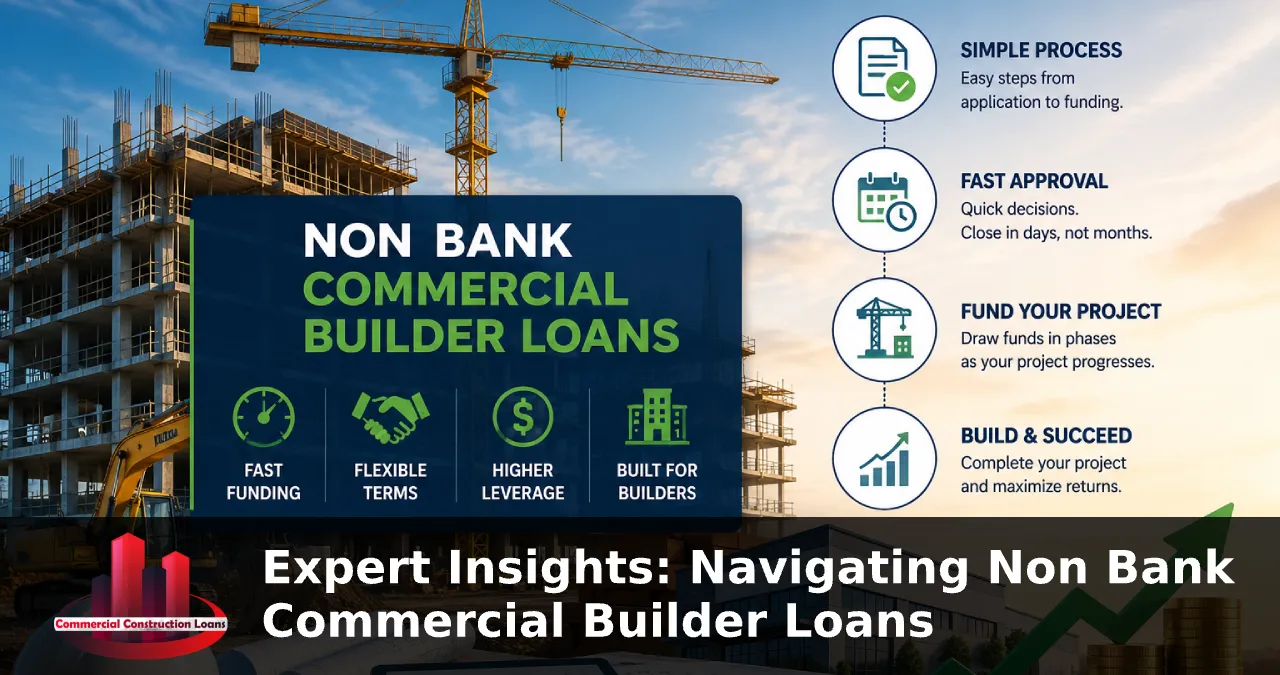
These loans disburse money in phased draw payments rather than one big payout. You pay interest only on funds you actually draw down.
The funding process moves through simple steps:
Phase 1: Site purchase and horizontal site work.
Phase 2: Vertical construction funded through progress draws.
Phase 3: Project completion, lease-up, and permanent refinancing.
Lenders build an interest reserve directly into your total loan facility. This reserve pays monthly interest charges while you build. You avoid out-of-pocket cash drain before your building generates income.
Inspectors check job site progress when you submit a draw request. Direct private lenders release draw funds in 48 to 72 hours. Banks often take three to four weeks for the exact same draw. Fast draws keep your subcontractors working and keep your project on schedule.
Private lenders use basic mathematical formulas to calculate your maximum funding:
Loan-to-Cost ratio:
LTC=LoanCommitmentTotalProjectCost
Loan-to-Value ratio:
LTV=LoanCommitmentCompletedAppraisedValue
Debt Service Coverage Ratio:
DSCR=NetOperatingIncomeAnnualDebtPayments
Banks limit LTC to 55% or 60%. Private platforms provide funding options for commercial builders without bank approval up to 75% or 85% LTC. Higher leverage preserves your working capital. You can run multiple job sites at once instead of tying up all your cash in one project. For a deeper look at how these ceilings are actually set deal-by-deal, see our breakdown of commercial construction loan LTC limits.
What Are the Main Types of Private Construction Funding?
Every commercial project needs the right financial tool. Specialized lenders offer distinct loan options across the property spectrum:
Direct Ground-Up Construction Loans
Ground-up builds require steady, heavy capital. Securing private lender commercial construction loans allows you to finance site prep, materials, and labor. These first-position senior loans cover industrial warehouses, retail plazas, self-storage facilities, and multi-family units. Loan terms run 24 to 48 months with interest-only payment structures. If your project has hit a financing wall mid-build, our ground-up construction financing rescue plan walks through how to restructure and keep moving.
Hard Money and Quick Bridge Facilities
Speed wins deals when you find distressed properties or fast infill sites. Hard money loans for commercial development close in 10 to 14 days. Lenders focus on land value and project equity rather than long tax returns.
Short-term bridge loans for commercial property development run 12 to 36 months. They fund adaptive re-use builds, gut remodels, and commercial property conversions. You finish the build, fill the property with tenants, and transition into long-term debt.
Government-Backed Takeout Conduits
Private construction facilities transition smoothly into permanent government programs once construction finishes. SBA 504 and 7(a) loans offer up to 90% financing for owner-occupied commercial properties. USDA Business & Industry loans fund projects in rural trade areas.
Larger multi-family developments can transition into FHA 221(d)(4) loans, Fannie Mae, Freddie Mac, or CMBS conduits. These permanent loans deliver 30-year fixed rates and low monthly payments.
Stated Income and Lite-Doc Programs
Tax filings do not always show your real financial power. Real estate investors use legal tax write-offs that lower reported income. Non traditional commercial real estate development loans offer stated-income and lite-doc choices. Lenders verify bank statements, pro forma cash flow, and asset values instead of tax returns.
Are You Ready to Pass Technical Due Diligence?
Private lenders move fast, but they complete thorough technical reviews. They check four distinct areas:
Market Demand: Appraisers check submarket vacancy, local rent growth, and buyer demand.
Construction Costs: Underwriters audit hard costs, soft costs, and contractor quotes. Guaranteed Maximum Price (GMP) contracts give lenders strong confidence. If costs have already run past budget, cost overrun financing for developers can bridge the gap without derailing the schedule.
Permits and Entitlements: Title reports, zoning approvals, and Phase I Environmental site assessments must be clear.
Sponsor Experience: Lenders evaluate past builds to confirm your team can execute the design.
Understanding qualifying for non-bank commercial builder loans helps you prepare your application. Standard requirements include:
- A credit score of 620 or higher.
- Liquid cash reserves equal to 10% to 15% of total construction costs.
- A track record of 2 to 3 successful builds in the last 5 years.
- Projected cash flow that covers debt service by 1.15x to 1.25x.
Knowing where to get commercial construction loans non-bank makes your search simple. Working directly with an established wholesale platform like our loan products page connects you straight to deep private capital reserves.
Banks vs. Private Lenders: Which One Fits Your Project?
Comparing your funding options helps you make smart capital decisions.
Evaluating pros and cons of non-bank commercial development loans shows clear trade-offs. Private loans carry interest rates 2% to 4% higher than bank loans. They charge 1 to 2 origination points at closing.
Higher leverage balances out higher interest costs. A bank requiring 45% cash down ties up your capital. A private lender requiring 15% down keeps your cash free for new opportunities. Speed and flexibility often generate far more profit than lower interest rates save — though as recent reporting on bank credit risk points out, both banks and private lenders are watching construction and transitional CRE exposure closely right now, so terms can shift with the cycle.
Reviewing a comparison of non-bank commercial construction lenders alongside traditional banks reveals clear operational differences:
| Key Feature | Traditional Depository Bank | Non-Bank Wholesale Lender |
| Approval Speed | 60 to 120 days | 15 to 30 days |
| Max Loan-to-Cost (LTC) | 55% to 65% LTC | 70% to 85% LTC |
| Personal Recourse | Full personal guarantee required | Non-recourse options available |
| Tax Return Requirements | 3 years of full tax returns | Lite-doc and stated income available |
| Draw Turnaround | 10 to 20 business days | 2 to 5 business days |
| Deposit Account Rules | Mandatory deposit accounts required | No deposit accounts required |
If your project is already underwater on its original construction loan, our guide to commercial construction rescue capital covers how repositioning financing works in practice, and the CRE construction crisis overview explains why so many developers are facing this choice at the same time.
How Do Intermediaries and Broker Programs Fuel Your Growth?
Intermediaries link real estate investors directly with private wholesale capital. Correspondent lenders and table funders streamline every transaction.
In a table-funding setup, the correspondent lender approves and funds the loan at closing using dedicated capital lines. The transaction closes directly in the lender’s name. This removes loan committee delays and keeps your closing date secure.
Wholesale platforms like CommercialConstructionLoans.Net bring 30 years of underwriting experience to every file. They offer access to 75 loan varieties across the nation. They finance ground-up builds, gut renovations, fix-and-flips, tear-and-rebuilds, fix-and-rents, and long-term fix-and-holds.
Commercial mortgage brokers gain big advantages through structured referral programs:
Exclusive Programs: Direct connection to wholesale desks, protected commission structures, and priority underwriting.
Non-Exclusive Programs: Flexible placement for unusual properties, clear payouts, and rapid pricing quotes.
How Can You Smartly Navigate Non Bank Commercial Builder Loans?
The real estate market favors fast, adaptable builders. Traditional banks continue to pull back from commercial development loans. Private debt platforms provide the speed, leverage, and reliability you need to build.
You scale your business faster when you pair solid construction plans with reliable capital. Securing non bank commercial builder loans gives you total control over your project timelines, cash reserves, and long-term profits. Connect with a specialized wholesale correspondent lender today and turn your commercial construction plans into real property.
FAQs
Can foreign investors get non-bank commercial builder loans?
Yes. Foreign nationals can secure non-bank commercial builder funding without standard domestic credit files. Lenders base approval on project cash flow, experienced local contractors, and higher equity stakes. You can close quickly through domestic entity structures.
Do non-bank builder loans charge prepayment penalties?
No. Most private construction loans do not penalize you for paying early once you finish construction. Some facilities require minimum interest guarantees for six months. After that initial period ends, you can pay off the loan anytime.
Can builders roll land equity into loans?
Yes. Direct private lenders allow you to credit existing land equity toward your cash down payment. If your land increased in value through zoning or permits, underwriters apply that appreciated value directly toward your required project equity.
Are environmental site assessments required for approval?
Yes. Private lenders require a clean Phase I Environmental Site Assessment before closing any deal. This report proves your land contains no hazardous waste or toxic spills. A clear test protects your asset value and speeds final underwriting.
Can you fund raw land without permits?
No. Most private construction loans require approved site plans and active building permits before vertical funds disburse. You can obtain specialized bridge land loans first, but full construction draws remain locked until cities grant all final permits.
Comments are closed