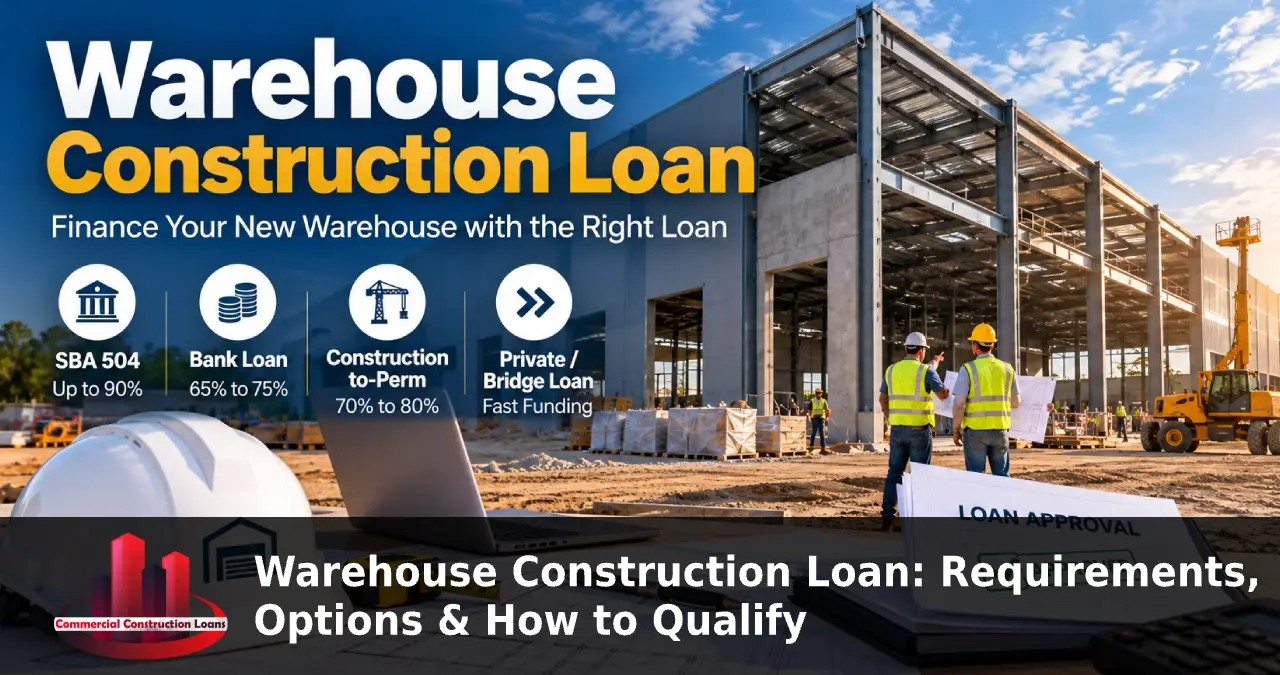
A warehouse construction loan pays for a new warehouse as work gets done. Most lenders fund 65% to 80% of the cost. You add 20% to 35% in cash or land. Banks want a 680 credit score or more. They also want cash set aside and a builder with a good record.
Private lenders move fast and bend more. CommercialConstructionLoans.Net works with both. This guide shows how each loan works, what it costs, and how to get a yes.
Is Now a Good Time to Build a Warehouse?
The market is mixed. But warehouse demand is up.
Here is the big view. Private builders spent at a pace of $1.655 trillion a year in August 2026, per U.S. Census Bureau construction data. Private nonresidential work was $773.0 billion of that. Total spend is still a bit below last year. So not every type of building is booming.
Warehouses are different. Per Cushman & Wakefield’s third quarter report, a few facts stand out:
- Vacancy fell to 6.8%. That is the lowest since the end of 2024.
- Net absorption hit 76.6 million square feet. That is the best quarter since early 2023.
- The build pipeline grew to about 324 million square feet. That is up 23% in a year.
- Asking rents rose 4% in a year.
Supply chains are also moving closer to home. Harvard Business School research shows U.S. buyers sourcing less from China. They are sourcing more from Mexico and Vietnam. That can lift the need for space near ports, roads, and big cities.
Lenders still check each deal with care. A strong plan wins.
Which Warehouse Loan Fits Your Plan?
Your plan sets your loan. Who will use the building matters most.
| Loan Type | Typical Loan Size | Rate Type | Best For |
| SBA 504 loan | Up to 90% | Fixed on the SBA part | Owners who use the space |
| Bank construction loan | 65% to 75% | Floating | Investors and owners |
| Construction-to-perm loan | 70% to 80% | Floating, then fixed | Long-term holders |
| Private build or bridge loan | 70% to 80% | Short term, interest only | Spec builders and fast deals |
SBA 504 vs. Private Construction Loan
The SBA 504 loan is hard to beat if you run a firm and will use the building. A bank funds about 50%. A Certified Development Company funds up to 40%. You put in as little as 10%.
Here are the rules, from the SBA 504 loan page:
- The SBA part tops out at $5.5 million.
- Terms run 10, 20, or 25 years.
- The rate tracks 10-year Treasury yields.
- You can’t use it for rental property or a bet on the market.
For a new build, you must use at least 60% of the space. Many lenders also want a plan to reach 80% in time if you rent out the rest. Start-ups and special-use sites often need 15% down. If you are both, plan on 20%.
Plan to rent the whole building? Skip the SBA. Use a private or bank loan. These look at the worth of the project and the rent it can earn. They don’t care who lives in it.
Construction-to-Perm Loans
This loan joins your build loan and your long loan in one deal. You pay interest only on the money you draw. When the city gives you a Certificate of Occupancy, the loan flips. You pay closing, legal, and value-check fees once.
Business loans are not like home loans. Many run 3 to 10 years. The payments may be set on a 25 or 30 year plan. Ask what happens when the term ends.
Bridge Loans
Sometimes you must move fast. You may need to buy land or start site work before plans are done. A bridge loan gives quick cash based on what the land is worth. It can hold your spot until you land a long loan.
Spec, Build-to-Suit, or Flex: What Will Lenders Think?
Lenders judge your loan by the kind of building you plan.
| Building Type | What It Is | What Lenders Watch |
| Speculative (spec) | No tenant signed yet | Your cash on hand |
| Build-to-suit | Custom build for one signed tenant | Tenant credit and lease |
| Flex | Warehouse plus office or showroom | Steady rent from many tenants |
| Bulk distribution | Large floor, many dock doors | How fast it will lease |
Spec warehouses carry the most risk. Lenders often cap the loan at 60% to 65% of cost. They also want an interest reserve. That is cash set aside to pay interest while you seek tenants.
Build-to-suit warehouses are easier to fund. A lease from a strong tenant cuts the risk. You often get a bigger loan and a lower rate.
Flex and light industrial sites spread risk over many small tenants. If one leaves, the rest still pay. Lenders like that steady cash.
Which Ratios Set Your Loan Size?
Lenders use four plain ratios.
| Ratio | What It Means | Common Target |
| Loan-to-cost (LTC) | Loan over total project cost | 65% to 80% |
| Loan-to-value (LTV) | Loan over what the site is worth | 60% to 75% |
| Debt coverage (DSCR) | Yearly net income over yearly loan payments | 1.20 to 1.35 |
| Debt yield | Yearly net income over the loan | 8% to 10% |
Net income here is net operating income, or NOI. It is rent minus the cost to run the place.
Total cost counts hard costs like steel, concrete, and labor. It also counts soft costs like plans, permits, and interest. Lenders then pick the lower of two numbers:
Max loan = the smaller of (total cost x LTC cap) or (value x LTV cap)
Here is an example. Your project costs $10 million. The LTC cap is 65%. The finished site should be worth $13 million. The LTV cap is 65%.
- Cost test: $10 million x 65% = $6.5 million
- Value test: $13 million x 65% = $8.45 million
- Max loan: $6.5 million
- Your cash in: $3.5 million
Debt yield and DSCR come into play at the end. Before you build, there is no rent yet. So lenders test what the done site could earn. Say it earns $650,000 in NOI. Say the loan costs $500,000 a year. Your DSCR is 1.30. On a $6.5 million loan, your debt yield is 10%. Both pass most tests. Federal bank examiners look at these same marks when they review loans.
Want more? Read our guides on commercial construction loan LTC limits and max loan-to-cost lenders.
How Much Cash Do You Need Up Front?
Most lenders ask for 20% to 35% of total cost. SBA 504 loans ask for 10% to 20%.
You may not need cash. If you own the land, its worth can count. Say you bought a lot years ago and it grew in worth. Many lenders let you use that gain as your share.
What Do Lenders Check Before They Say Yes?
Here is the usual list:
- Record. Show past projects like this one.
- Credit. Banks want 680 or more. A score above 720 gets better rates. Some private plans start near 600.
- Cash set aside. Many lenders want 6 to 12 months of payments in the bank.
- Net worth. Some banks want it close to the loan size.
- Builder. Your builder must be licensed, bonded, and insured. Past warehouse work helps.
- Site checks. Expect a value check and a Phase I environmental report. Most warehouse sites need one.
- Zoning and permits. Show the site allows your plan, or that approval is on track.
- A real budget. Add a line for surprise costs.
- A personal guarantee. Lenders often want one during the build. Ask how to drop it once the place is leased.
- An exit plan. Show how you will pay off or swap the loan when the build ends.
What Does a Warehouse Construction Loan Cost?
Rates hinge on the lender and the risk. Most floating loans use a base rate plus a spread. A common base is SOFR. It sat near 3.9% in early October 2026, per New York Fed data. Your lender adds its spread on top.
Our current ranges come from our loan products page. They change, so call for a live quote.
| Program | Base Rate Range | Typical Term | Loan Cap |
| New build | 9% to 12% | 1 to 3 years | Up to 80% of cost |
| Business bridge | 10% to 12% | 1 to 2 years | Up to 70% of value |
| SBA 504 and 7(a) | 7% to 9% | 20 to 30 years | Up to 85% of value |
Rates are just part of the cost. Plan for these too:
- Interest reserve
- Value and site reports
- Title, legal, and inspection fees
- SBA fees, near 3% of the debt, which you can fold into the loan
Private loans cost more than bank loans. In return, you get speed and room to bend. Many builders start with a private loan and swap later. Our guides on non-bank commercial builder loans and private debt funds for construction explain the trade-off.
How Do You Find the Right Lender?
You have three main choices:
- Banks. Low rates, strict rules.
- Private debt funds. Fast, and they focus on the asset.
- Correspondent and wholesale lenders. They match your deal to the best source.
We are a correspondent lender, table funder, and wholesale lender. We bring 30 years of loan review to your deal. We work with hard money, DSCR, SBA, USDA B&I, FHA, Fannie Mae, Freddie Mac, and CMBS plans. We fund ground-up construction. We also help stalled jobs with a private lender for mid-build projects.
Are you a broker? We have direct referral plans for you. See our full list of loan products.
How Does the Loan Process Work?
Here are the four steps:
- Send your package. Share plans, a budget, the land deed, and bank records.
- Get a term sheet. We check your ratios and send clear terms.
- Pass the outside checks. An expert checks value. Another checks the site.
- Close and draw. You sign and add your cash. We pay out as work gets done.
How Draws Work
- Your builder ends a phase, like the slab, and sends a draw request.
- An inspector visits and checks the work.
- The title firm looks for liens.
- We wire the funds to your project account.
Small light industrial builds often take 6 to 12 months. Large hubs can take 12 to 24 months. SBA 504 deals often take 60 to 90 days to close. So start early.
What Mistakes Sink Warehouse Loans?
Avoid these:
- Picking an SBA loan when you plan to rent the whole place
- Leaving out a line for surprise costs
- Skipping the interest reserve on a spec build
- Hiring a builder with no warehouse record
- Waiting to check the site until after you buy the land
- Having no exit plan
Ready to Fund Your Warehouse?
Pick the right loan and you can build without draining your cash. Tell us about your site, your plans, and your timeline. We will match you with terms that fit.
Contact CommercialConstructionLoans.Net today to get a direct quote on your warehouse construction loan.
Frequently Asked Questions
What is a warehouse construction loan?
It is a short loan that pays for a new warehouse in stages. You draw funds as work gets done. When the build ends, you pay it off or swap it for a long loan.
How much down payment do I need?
Plan on 20% to 35% of total cost for most private and bank loans. SBA 504 loans start at 10%. Land you own can count toward your share.
What credit score do I need?
Banks want 680 or more. Some private lenders start near 600. But the rate may rise, and you may need more cash in.
Can I use an SBA 504 loan to build and rent out a warehouse?
No. SBA 504 funds can’t go to rental property. You must use at least 60% of a new building.
How long does it take to build a warehouse?
A small light industrial site often takes 6 to 12 months. A large hub can take 12 to 24 months.
Comments are closed