
Over $3.2 trillion in dry powder sits waiting in global private market funds right now. Financial reports from Morgan Stanley and Brookings show that private credit expanded to $1.5 trillion in 2024 and is heading toward $3.0 trillion by 2028. Harvard Business School research reveals that institutional investors increased their allocations to alternative assets like private debt from 14% to 39%. Federal Reserve surveys show that commercial banks are locking down their vaults, rejecting new loans, and restructuring 66% more troubled real estate debt. Traditional banks are stepping backward, but capital is flowing fast elsewhere. Smart real estate investors are taking action today before competitor builders claim this massive pool of cash.
Securing flexible financing decides whether your ground-up construction breaks ground or stalls out. Conventional bank channels are failing active sponsors. Modern real estate developers use private debt funds for construction to secure rapid funding, maximize capital leverage, and build properties without institutional delays.
At CommercialConstructionLoans.Net, we act as your correspondent lender, table funder, and wholesale direct lender. With 30 years of underwriting experience, we help both experienced developers and first-time investors navigate complex market conditions. We do not handle retail underwriting directly, but our decades of underwriting background ensure that your capital stack stays solid. We provide access to 75 loan varieties, supporting brokers and real estate sponsors across the country.
Why Are Traditional Banks Leaving Developers Stranded?
The Contraction of Bank Balance Sheets and the Rise of Direct Lending
Commercial banks are backing away from land development and ground-up construction loans. Regulatory pressures force conventional lenders to hold onto cash reserves and avoid market risks. Recent Federal Reserve Bank of St. Louis data shows a 66% surge in modified commercial real estate loans sitting on bank balance sheets.
This balance sheet pressure creates immediate problems for active real estate builders. Banks cancel credit lines, request higher cash deposits, and drag out simple loan approvals for months. Investors who rely on conventional banks lose time and land contracts. Smart sponsors are turning to private construction loans without banks to protect their project timelines. Direct private lenders step into the gap with direct equity, fast decisions, and clear terms.
How Private Debt Funds Bridge the Commercial Funding Gap
Private credit funds pull capital from private family offices, institutional endowments, and private wealth funds. They operate outside rigid banking regulations. This means they fund active building projects based on real asset value rather than corporate red tape.
When a project makes commercial sense, private lenders act fast. They look at current land value, project drawings, and completed property appraisals. Their focus centers on developer success and property equity. Builders get access to alternative financing options for construction development that keep projects moving on schedule.
Private Debt vs Traditional Bank Loans for Construction: Which One Wins?
Comparing traditional bank loans with private debt funds reveals stark differences in timing, equity demands, and project execution.
| Financing Feature | Traditional Commercial Bank | Private Debt Fund | Investor & Developer Impact |
| Primary Underwriting Focus | Tax Returns, Global Cash Flow, Debt Coverage | Property Value, As-Completed Value (ARV), Feasibility | Enables funding for value-add, heavy rehab, and ground-up builds. |
| Approval & Closing Window | 60 to 120 Days (8 to 16 Weeks) | 14 to 30 Days (2 to 4 Weeks) | Secures time-sensitive land purchases and competitive acquisitions. |
| Maximum Loan-to-Cost (LTC) | 50% to 60% Maximum LTC | 80% to 85% LTC | Reduces upfront cash equity required from developers. |
| Documentation Standards | Full-Doc (Tax disclosures, global income) | Lite-Doc / No-Doc options based on asset equity | Streamlines approval processes and cuts administrative friction. |
| Repayment Structure | Amortizing Principal + Interest | Interest-Only during construction phase | Eases monthly cash flow pressure during construction. |
| Risk Tolerance Profile | Low (Strict regulatory guidelines) | High (Flexible, customized underwriting) | Accommodates complex, unique, or transitional property deals. |
Understanding private debt vs traditional bank loans for construction comes down to speed and opportunity costs. Bank loans offer lower interest rates on paper, but their slow processing speeds cost developers valuable deals. Private debt financing costs slightly more in nominal rate, but it delivers fast execution, high leverage, and lower equity hurdles.
Structural Differences: Balance Sheet Mechanics and Underwriting Speed
Banks pass every application through multiple loan committees, risk officers, and compliance boards. A single missing tax form can delay your project by six weeks.
Private debt funds use dedicated, in-house underwriting channels. Decision-makers review property metrics directly. You receive direct feedback, firm loan commitments in days, and full funding in two to four weeks.
Equity-Driven Underwriting vs. Rigid Financial Covenants
Standard bank underwriting relies on historical tax returns and personal debt service coverage ratios. Smart real estate investors use tax write-offs and depreciation to lower taxable income, which bank algorithms view as a financial weakness.
Private lenders focus on project quality, property location, and expected post-construction appraisal value. By evaluating equity rather than personal tax write-offs, private lenders approve strong commercial projects that banks turn down.
10 Key Benefits of Using Private Debt Funds for Construction Projects
Private credit offers powerful structural advantages for ground-up commercial projects, major renovations, and land development. Here are the key benefits of private debt for construction projects that top real estate sponsors use to build wealth.
Benefit 1: Rapid Deployment of Capital and Streamlined Closings
Real estate opportunities disappear while waiting for slow lenders. Land sellers favor buyers who close quickly. Private debt funds issue loan documents and close transactions within 14 to 30 days. Rapid capital funding lets you lock in purchase prices, secure general contractors, and start site work without delay.
Benefit 2: Superior Leverage and Flexible Loan-to-Cost Ratios
Cash preservation drives strong investment returns. Banks cap construction loans at 50% or 60% loan-to-cost, forcing you to tie up huge cash reserves. Private debt providers offer up to 80% or 85% loan-to-cost. Higher leverage keeps your cash liquid so you can run multiple active job sites at the same time.
Benefit 3: Customized Repayment Structures and Interest-Only Construction Draws
Active construction projects generate zero rental income during construction. Paying full amortizing debt service during construction strains cash reserves. Private debt structures use interest-only payment schedules during the building phase. You pay interest only on the money you draw, protecting cash flow until construction wraps up.
Benefit 4: Openness to High-Risk, Unconventional, and Complex Developments
Banks avoid complex projects, adaptive reuse builds, or heavy structural re-builds. Private debt managers excel in complex deal environments. They provide specialized capital like private debt funds for distressed construction assets, allowing sponsors to turn around stalled construction sites or incomplete properties.
Benefit 5: Asset-Value Centric Underwriting Over Credit History Constraints
Establishing the right criteria for private debt construction financing requires clear property value. Private lenders assess current land value, local market demand, and completed project valuations. Strong property collateral secures loan approval even if your corporate tax returns show complex depreciation structures.
Benefit 6: Reduced Bureaucracy and Direct Access to Decision-Makers
Working with regional bank staff often leads to changing terms and unreturned phone calls. Private debt funds give you direct communication with key underwriters and asset managers. Direct communication speeds up monthly draw reviews, budget line-item transfers, and field inspections.
Benefit 7: Integrated Industry Expertise and Strategic Project Guidance
Deep market insight matters when construction challenges arise. Deep experience in understanding private debt fund structures for construction allows lenders to anticipate supply chain shifts, permit delays, and trade labor costs. Private lenders act as real strategic partners, offering practical feedback on contractor agreements and construction timelines.
Benefit 8: Seamless Transition Structures into Long-Term Permanent Mortgages
Private construction debt provides an agile funding bridge during active building. Once construction finishes and tenant leases stabilize property income, your short-term debt transitions smoothly into long-term permanent financing. You can roll private construction loans directly into long-term DSCR loans or commercial portfolio mortgages without interrupting operations.
Benefit 9: Protection Against Opportunity Costs and Market Volatility
Evaluating the risks and rewards of private debt in construction comes down to timing and deal execution. Bank delays cost real money in extended land holding costs, contractor price increases, and missed selling windows. Fast private debt funding keeps construction moving, lowers land holding costs, and delivers completed space to market faster.
Benefit 10: Tailored Debt Stacking: Mezzanine, Preferred Equity, and Table Funding
Every commercial build requires a unique capital structure. Private debt providers offer flexible debt stacking models, including senior debt, mezzanine loans, preferred equity, and table funding facilities. These tailored capital options reduce your equity contribution while keeping your capital stack balanced.
Why Are Emerging Investors Choosing Private Debt Financing for Small Scale Construction?
First-time developers often struggle to get bank approval due to strict track-record requirements. Direct private lenders offer tailored financing options that give new developers access to commercial capital.
Using private debt financing for small scale construction opens up opportunities across several real estate sectors:
- Novice Developer Programs: Private lenders evaluate general contractor experience and project strength rather than demanding decades of personal builder history.
- Integrated Interest Reserves: Lenders package interest reserves into total loan facilities, covering monthly interest payments during active construction.
- Competitive Speed: Fast 14-day loan commitments empower new investors to win land deals over cash buyers.
- Low-Doc Qualification: Lite-doc programs evaluate property equity instead of demanding extensive personal tax disclosures.
- Portfolio Scaling: Completing your first private debt project builds instant track record and sets up future expansion.
Specialized private debt lenders for ground-up construction partner with builders to turn architectural concepts into profitable real estate assets. These programs give new sponsors a clear roadmap for long-term growth.
At the same time, institutional funds, such as private equity real estate debt funds for residential construction, supply capital for single-family subdivisions, townhome builds, and infill housing. This private liquidity provides flexible construction funding across all housing types.
How Do Draw Schedules, Interest Reserves, and Liquidity Work in Practice?
How Staged Capital Distributions Work
Private construction debt disburses through controlled draw schedules. Funds remain safe in escrow until project milestones are completed.
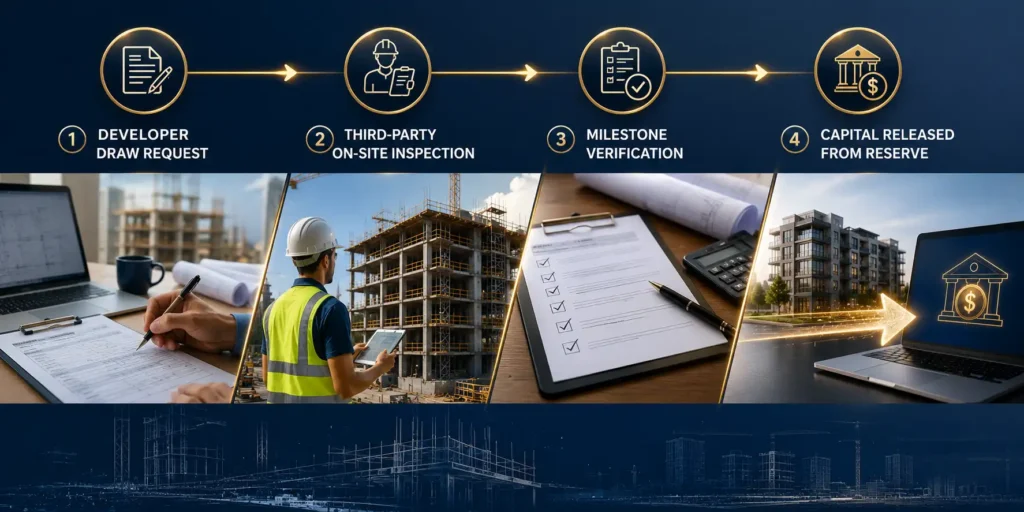
You request funds after completing building steps like foundation work, framing, electrical rough-ins, or interior finishes. An independent inspector verifies completed work on-site, and the lender releases the matching draw funds straight to your account within 48 to 72 hours.
Liquidity Verification and Risk Cushioning Requirements
Private lenders simplify underwriting requirements, but they verify that sponsors maintain baseline cash reserves to cover project surprises.
| Liquidity Parameter | Conventional Bank Expectation | Private Debt Fund Standard | Eligible Verification Accounts |
| Minimum Cash Down Payment | 30% to 50% Out-of-Pocket Cash | 15% to 20% Total Project Equity | Liquid Bank Balance, Land Equity, Cross-Collateral |
| Interest Reserve Structure | Out-of-Pocket Monthly Payments | Financed Directly into Construction Facility | Loan Reserves, Escrow Accounts |
| Liquidity Reserve Cushion | 12 to 24 Months Cash Reserve | 6 Months Interest Coverage Reserve | Checking Accounts, 50% IRA, 100% HELOC |
| Appraisal Evaluation Base | Conservative “As-Is” Property Base | “As-Is” and After-Repair Value (ARV) | National Valuation Firm Appraisals |
How Can CommercialConstructionLoans.Net Accelerate Your Next Deal?
Finding reliable private capital partners can feel overwhelming. Understanding how to find private debt funds for real estate development comes down to partnering with specialized correspondent lenders and table funders who understand real estate development from the inside out.
CommercialConstructionLoans.Net provides direct wholesale execution. Supported by 30 years of underwriting experience, our team structures custom financing solutions across ground-up construction, heavy renovations, fix-and-flip builds, tear-and-rebuilds, and hold portfolios.
Comprehensive Product Suite: 75 Commercial Loan Programs
We provide direct access to 75 commercial loan programs, matching you with the best private debt funds for commercial construction projects across the market:
| Loan Program Category | Target Borrower Audience | Eligible Property Assets | Max Leverage (LTC / LTV) | Primary Operational Advantage |
| Ground-Up Construction Debt | Experienced & Novice Commercial Developers | Multifamily, Mixed-Use, Retail, Industrial | Up to 85% LTC / 65% ARV | Financed interest reserves; structured draw schedules. |
| Commercial Bridge Facilities | Sponsors Acquiring Transitional Real Estate | Un-leased Commercial, Value-Add Portfolios | Up to 80% LTV | Fast 14-day closings; bridge to permanent stabilization. |
| Hard Money Capital | Fix-and-Flip & Heavy Rehab Investors | Infill Commercial, Residential Tracts | Up to 85% LTC | Asset-value centered; flexible low-doc options. |
| DSCR Rental Investments | Long-Term Buy-and-Hold Real Estate Owners | Tenant-Occupied Residential & Commercial | Up to 80% LTV | Underwritten on property cash flow without personal tax returns. |
| FHA Commercial & CMBS Debt | Owners of Stabilized Commercial Assets | Stabilized Multifamily, Industrial, Retail | Up to 75%–80% LTV | Long-term fixed rates; non-recourse debt options. |
| SBA & USDA B&I Programs | Owner-Occupied Business Enterprises | Rural Commercial, Manufacturing Assets | Up to 90% LTV | Government-backed capital featuring extended amortization windows. |
Knowing how to apply for private construction debt financing is simple with our streamlined process. Submit your executive summary, architectural plans, construction budget, and property location to receive a custom loan proposal.
Correspondent Lending, Table Funding, and Wholesale Capital Execution
We act as your correspondent lender and wholesale direct funder. Funding transactions directly at the closing table eliminates third-party delays, ensures capital reliability, and simplifies financing for complex commercial deals.
Wholesale Referral Programs for Mortgage Brokers and Intermediaries
We offer exclusive and non-exclusive referral structures for mortgage brokers and loan originators. Whether you are an experienced commercial broker or expanding into commercial loans for the first time, our platform provides full backend processing, dedicated underwriting support, and reliable commission payouts across all 75 loan products.
Is It Time to Secure Private Debt Funds for Construction Projects?
The commercial construction market is moving forward fast. Traditional bank lending rules leave real estate developers stranded, but direct private debt provides instant capital, flexible terms, and strong project leverage. Evaluating your project capital needs today reveals why real estate investors rely on private debt funds for construction to secure land, start building, and maximize investment returns.
Do not let bank delays slow down your growth. Contact CommercialConstructionLoans.Net today to discuss your construction project, review custom loan scenarios, and secure direct capital for your next commercial build.
FAQs
Q1: Can land equity count as a down payment?
A1: Yes. Private debt funds allow you to use existing land equity toward your required down payment. If you have owned the parcel for over two years, lenders count property appreciation directly toward your overall project equity contribution.
Q2: Do private lenders cover pre-development land costs?
A2: Yes. Private debt lenders provide specialized capital facilities for pre-development needs, including initial land acquisition, infrastructure site work, and early engineering costs. This quick capital access helps real estate developers secure property purchase options without facing bank delays.
Q3: Are retirement accounts eligible for liquidity reserves?
A3: Yes. Private construction lenders routinely accept 50% of your verified Individual Retirement Account balance to meet required post-closing liquidity cushions. Lenders also accept 100% of available Home Equity Line of Credit funds to satisfy reserve rules.
Q4: Can you finance appraisal costs into debt?
A4: No. Third-party appraisal fees and initial environmental reports must be paid upfront before underwriting approval. However, once your loan approves, private debt lenders can finance additional closing fees and interest reserves directly into your total loan facility.
Q5: Do private debt funds penalize early repayment?
A5: No. Most private construction lenders design their short-term loan facilities with flexible exit strategies and minimal prepayment penalties. This flexibility allows real estate sponsors to refinance into long-term debt or sell completed units as soon as construction wraps up.
Comments are closed