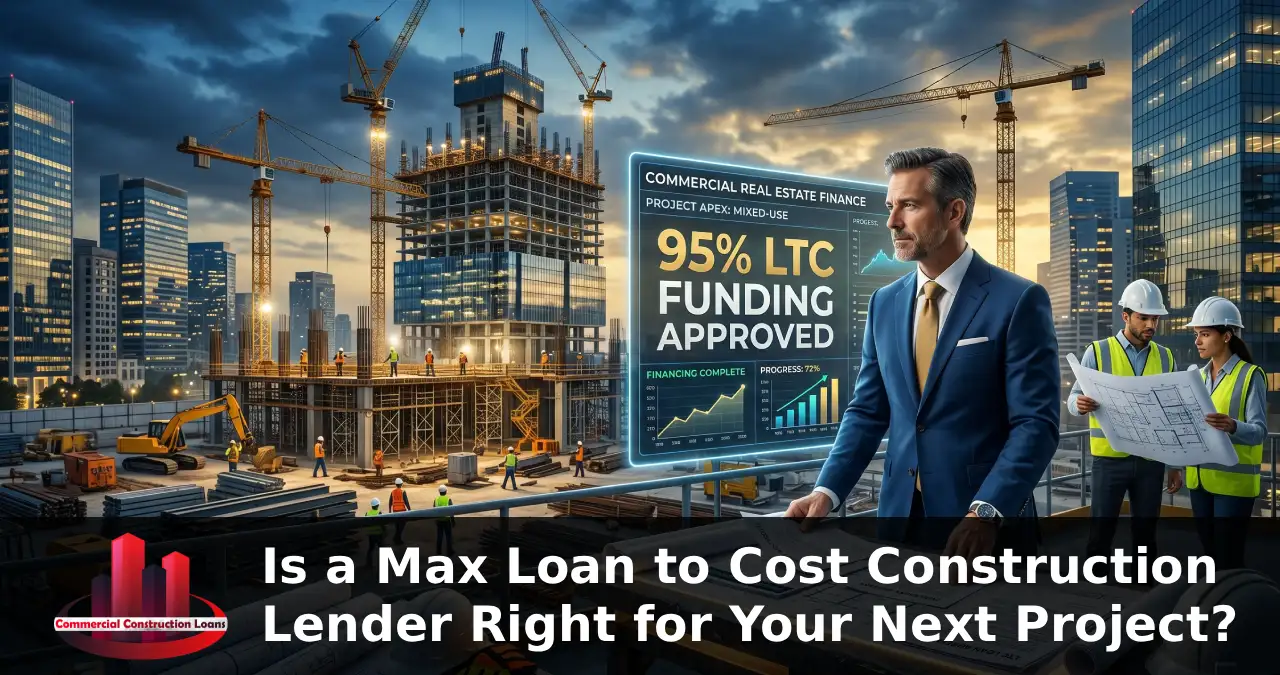
Right now, 91% of active real estate developers are missing out on prime land acquisitions. They fail because they cannot raise enough cash fast enough. While you sit and wait for your local bank to approve a measly 60% loan, your competitors are already pouring concrete. They use a special class of funders to bypass the equity trap. Finding a reliable max loan to cost construction lenders can completely change how you build.
What are the Core Mechanics of loan-to-cost in Commercial Real Estate?
What does LTC actually mean for your wallet? Think of it like buying a bicycle and adding custom parts. Does the bank only pay for the metal frame? No, you want them to pay for the wheels, the chain, and the leather seat.
Let’s explain the maximum loan-to-cost ratio for commercial construction. It is the absolute highest percentage of your total project budget that a lender will fund. This budget includes land, architectural fees, permits, and construction costs.
Let’s look at the math. The formula for LTC is:
LTC = {Total Loan Amount}\{Total Project Cost}
Now, let’s look at max loan-to-cost vs. loan-to-value construction. Many new builders confuse these two. Loan-to-value (LTV) compares your loan amount to the property’s value after it is completed. That future value is speculative. Your appraiser guesses what the market will look like in two years.
The LTV formula is:
LTV = {Total Loan Amount}\{As-Completed Appraised Value}
If a lender sizes your loan based on LTV, they ignore your actual build budget. If they use LTC, they look at your real-world invoices and land costs. Private lenders prefer LTC because it protects them against market value fluctuations. It also lets them give you more cash up front.
LTC vs. LTV Parameter Metrics
| Operational Dimension | Loan-to-Cost (LTC) | Loan-to-Value (LTV) |
| Underwriting Focus | Real budget costs | Future appraised value |
| Main Phase | Active build phase | Refinancing phase |
| Market Risk | High cost protection | High valuation protection |
How Does the Macroeconomic Environment Impact Your Credit Supply?
The lending market has shifted. Traditional banks are pulling back. Outstanding commercial real estate debt has climbed to $6 trillion. Regional and small banks hold a massive portion of this debt.
A Federal Reserve study shows small banks increased their share of construction loans from 10% in 2015 to 40% recently. These small banks are now highly exposed. Because of this, they are tightening their rules.
US Census Bureau data show that total construction spending reached $2,172.4 billion in April 2026. Private residential buildings sit at $909.9 billion. Office properties reached $113.9 billion. While spending is high, getting money from a standard bank is harder than ever.
Many banks now limit you to 65% LTC. That means you have to bring 35% cash to the table. For a $10 million build, you need $3.5 million of your own cash.
That is why private construction lenders’ max loan-to-cost focus has changed. These non-bank lenders do not face the same strict government limits. They are willing to fund up to 85% or 90% of your costs. They help you build even when local banks say no. They look at the strength of your deal, not just regulatory boxes. This is crucial for maximizing the loan-to-cost ratio in ground-up construction projects.
To make an accurate comparison of max loan-to-cost construction lenders, look at their closing times and rate indexes.
Is a Max Loan to Cost Construction Lender Right for Your Next Project?
You have options. You do not have to beg your local bank. High-leverage debt comes in many structures.
Let’s look at the highest-loan-to-cost construction financing options on the market.
First, you have government-backed programs. FHA and HUD offer the Section 221(d)(4) program. This program can fund up to 85% to 90% of your costs. It is non-recourse. You do not have to sign away your personal home. The downside? It takes up to nine months to close.
Second, you have private debt funds and hard money lenders. These groups move fast. They can close in two weeks. They fund up to 85% or 95% of your costs. They charge higher interest rates, but they save your deal from dying.
Let’s classify these loan programs. We offer access to 75 different loan varieties at CommercialConstructionLoans.Net. While we do not underwrite directly, our team has 30 years of underwriting experience. We package your deal so institutional funders approve it on the first try.
Loan Categories and Leverage Limits
| Loan Category | Typical Leverage | Closing Speed | Personal Recourse |
| Agency HUD | Up to 90% LTC | 180 to 270 Days | No |
| Private Debt | Up to 85% LTC | 14 to 30 Days | Varies |
| Hard Money | Up to 95% LTC | 7 to 14 Days | Yes |
| SBA Commercial | Up to 90% LTC | 60 to 90 Days | Yes |
Strategic Breakdown of LTC Lender Tiers
| Lender Tier | Max LTC Allowed | Primary Benefit | Main Drawback |
| Tier 1 Banks | 65% LTC | Lowest interest rate | High cash required |
| Tier 2 Debt Funds | 80% LTC | Faster closing time | Mid-range fees |
| Tier 3 Hard Money | 95% LTC | Maximum cash leverage | High interest rate |
Why Should You Consider a Construction Loan Without Traditional Equity Requirements?
Let’s talk about cash preservation. Why do developers seeking maximum loan-to-cost construction loans want high leverage? It is about your Internal Rate of Return (IRR).
If you put less cash into a deal, your profit margins can skyrocket. You get a construction loan without traditional equity requirements, such as a 40% down payment.
Let’s look at a real example of a $13 million project. You buy land for $12 million. You need $1 million for renovations.
LTV vs. LTC Capital Structure Model
| Financial Metric | LTV-Limited Loan | Cost-Inclusive LTC Loan |
| Land Purchase Price | $12,000,000 | $12,000,000 |
| Renovation Cost | $1,000,000 | $1,000,000 |
| Total Project Cost | $13,000,000 | $13,000,000 |
| Lender Leverage Limit | 70% of Land Cost (LTV) | 70% of Total Cost (LTC) |
| Total Loan Approved | $8,400,000 | $9,100,000 |
| Required Cash Equity | $4,600,000 | $3,900,000 |
| Cash Equity Preserved | $0 | $700,000 |
Look at that. The LTC loan puts $700,000 back in your bank account. You can use that cash to buy your next property.
This model works across different construction styles:
- Ground-Up Projects: Build from scratch. Cover your hard materials and soft permits.
- Remodeling & Renovation: Upgrade an old apartment building. Increase the rents and refinance.
- Fix-and-Flip: Buy, rehab, and sell in under a year.
- Tear-and-Rebuild: Knock down a bad structure. Build a brand new asset.
What Are the Real Costs Behind High Leverage Construction Funding?
Higher leverage means higher risk for the lender. To protect themselves, lenders charge higher rates on high-LTC loans. You must understand construction-loan interest rates and maximum LTC structures before you sign.
Many high-leverage programs use a bridge-to-construction loan with a max loan-to-cost setup. This is a short-term loan. It funds the build, then rolls into a permanent mortgage once the building is at full occupancy.
During the build, you have no tenants. You have no income. How do you pay the mortgage? Lenders build an interest reserve into your loan. The lender pays itself using your loan proceeds. This keeps you out of default while you build.
Fee and Pricing Structure by Leverage Level
| Leverage Level | Base Rate Structure | Upfront Points | Exit Fees |
| Under 65% LTC | SOFR + 2.50% | 0.50% to 1.00% | None |
| 65% to 80% LTC | SOFR + 3.50% | 1.00% to 1.50% | 0.25% |
| 80% to 95% LTC | 9.25% to 12.00% Fixed | 1.50% to 2.50% | 0.50%+ |
Underwriting Standards and Qualification Frameworks
How do you qualify? Getting a high-leverage loan is not easy. Underwriters look at your history.
To qualify for max loan-to-cost construction financing, you need to show you can finish the job. Underwriters examine your past projects. They want to see similar builds completed on time.
For experienced developers, max-loan-to-cost construction programs offer massive perks. If you have built five successful projects, lenders will waive many cash reserve rules. They will lower your rates. If you are a novice, you can still get funded, but you will need a strong contractor by your side.
Underwriting Matrix by Sponsor Profile
| Sponsor Tier | Minimum FICO | Past Project Track Record | Net Worth Rule | Post-Close Cash |
| Tier 1 (High Leverage) | 740 | 5+ projects completed | Equal to loan amount | 15% of loan |
| Tier 2 (Mid Leverage) | 700 | 2 to 4 projects completed | 75% of loan amount | 10% of loan |
| Tier 3 (Low Leverage) | 640 | 0 to 1 projects completed | Case-by-case | 5% of loan |
How to Find a Construction Lender with High LTC Fast?
Do not waste weeks cold-calling local retail banks. They do not have the flexibility you need.
If you want to find a construction lender with high LTC, look to wholesale markets. Work with a correspondent network. These networks work with multiple capital sources. They know which funder has cash ready right now. They help you find the best construction lenders for high-leverage projects without hurting your credit score.
If you are a broker, we offer exclusive and non-exclusive referral programs. You can submit deals and earn competitive commissions.
Broker Referral Program Comparison
| Program Feature | Exclusive Referral | Non-Exclusive Referral |
| Commission Share | Higher percentage split | Standard rate split |
| Underwriting Help | Dedicated team analyst | Standard queue review |
| Protected Territory | Yes | No |
Your Strategic Action Plan
Before you choose a lender, map out your project details. Look at your cash, your team, and your market.
Financing Decision Matrix
| Project Metric | Choose High LTC (80%-95%) | Choose Low LTC (50%-75%) |
| Available Cash | You want to keep cash liquid | You have excess cash reserves |
| Local Market | High growth, high demand | Unstable or slow market |
| Build Team | Highly experienced GC | New or unproven team |
| Exit Plan | Quick sale or rapid refinance | Long-term hold |
When you need to keep your money moving, finding the right max loan to cost construction lender is the best move. It keeps your equity in your pocket. It lets you scale your business faster. Talk to our team at CommercialConstructionLoans.Net. Let our 30 years of underwriting experience design the perfect capital stack for your next build.
FAQs
Can land equity count as a down payment?
Yes. If you already own the building lot outright, lenders allow you to use your existing land equity to satisfy the down payment requirement. This means you can quickly get funded without putting additional cash into the deal.
Can you get loans with bad credit?
Yes. While lower credit scores mean higher rates, some private lenders approve projects with scores as low as 600 or 640. They look at your project’s overall value rather than just personal score history.
Do HUD loans require personal guarantees?
No. Programs like HUD 221(d)(4) offer completely non-recourse debt. This means your valuable personal assets, such as your family home, are completely safe because the lender has no personal recourse against you if your construction project defaults.
Do construction loans cover landscaping costs?
No. Most construction loans only fund structural costs, permits, materials, and vertical development. Lenders typically exclude non-permanent items like landscaping, furniture, and cosmetic upgrades, meaning you must pay for those extra project expenses using your own cash reserves.
Can LTC ratios exceed one hundred percent?
No. A loan amount cannot exceed all project costs because lenders require you to have some skin in the game. You will always need to bring some personal equity to cover closing gaps or potential overruns.
Comments are closed